The Appliance Experts
Stop Renting Customers™
APPLIANCE REPAIR LEAD GENERATION
Should You Buy Pay Per Call Leads or Build Your Own Customer Pipeline?
If you’re looking for more appliance repair leads, you’ve probably come across companies offering pay per call, exclusive leads, and lead generation services…
…These approaches can work. But they produce very different businesses.

More Calls
Get Faster Calls

Build Trust
Earn 5-star reviews

Increase Visibility
Rank higher on Google

Own Your Business
Customers, Reviews, and Visibility You Control

THE QUICK ANSWER
Pay-per-call leads can provide immediate opportunities, but they stop when the budget stops. The smartest appliance repair companies use paid leads strategically while building Visibility Assets™ that continue generating calls long after the advertising spend is gone.
At first glance, the idea is appealing. Your phone rings, you book more service calls, and you only pay when someone contacts your business.
For many companies, pay per call can be an effective way to generate business—especially when you’re just starting out, expanding into a new service area, or trying to keep technicians busy during a slow season.
But there’s an important question every business owner should ask before investing heavily in any lead generation program.
What happens when you stop buying leads?
If your phone stops ringing the moment your advertising budget stops, you’re not building a marketing system—you’re renting one.
That’s why successful appliance repair companies eventually shift their focus from simply buying leads to building marketing assets they own.
In this guide, we’ll explain how appliance repair pay per call works, when it makes sense, where it falls short, and how to build a business that generates customers long after the advertising spend is gone.
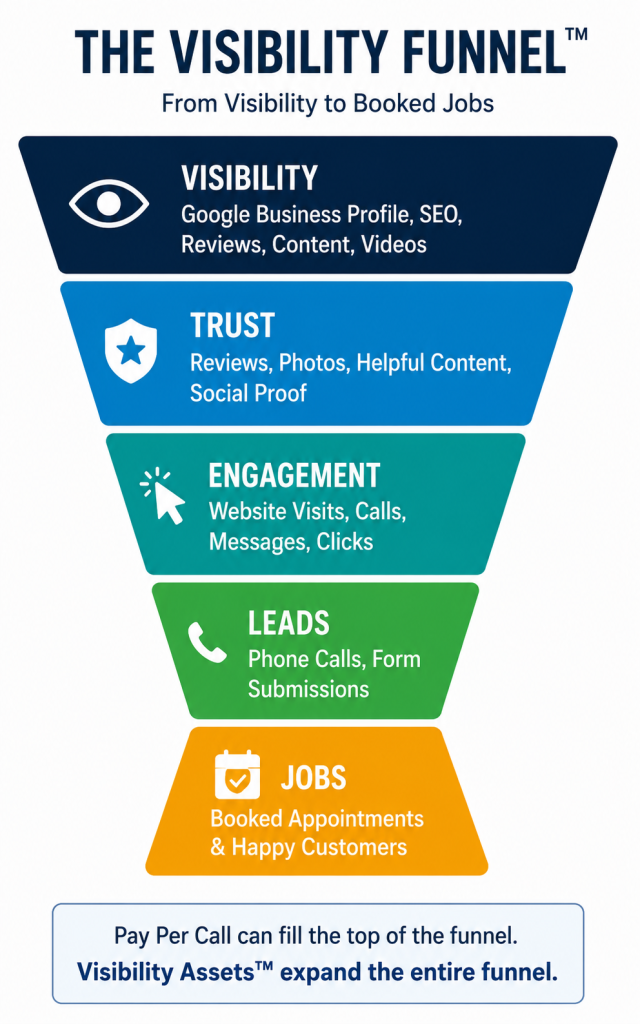
What Are Appliance Repair Pay Per Call Leads?
Pay per call is exactly what it sounds like.
Instead of paying for impressions, clicks, or monthly advertising, you pay when a potential customer calls your business.
Some providers sell exclusive calls that are sent only to your company, while others may distribute leads to multiple contractors depending on the program.
The biggest advantage is speed.
A new website or local SEO campaign can take months to gain traction, while pay-per-call campaigns can begin generating phone calls much more quickly.
For companies that need work immediately, that can be extremely valuable.
The Advantages of Pay Per Call
There are several reasons appliance repair companies choose pay-per-call programs.
Immediate Lead Flow
One of the biggest advantages is that calls can begin almost immediately after a campaign starts.
Predictable Growth
If your cost per booked appointment is profitable, increasing your budget often results in more calls.
No SEO Learning Curve
You don't have to understand Google Business Profile optimization, search engine optimization, or website marketing to start receiving leads.
Great for New Businesses
When you're just getting started, buying leads can help generate revenue while you build your reputation and customer base.
The Hidden Cost Most Contractors Never Calculate
Pay per call solves one problem.
It generates calls.
But it often creates another problem that many owners don’t recognize until years later.
The business becomes dependent on purchased customers.
Every month begins the same way.
You need leads.
You increase your advertising budget.
The phone rings.
Then next month, you start over again.
The marketing never compounds because you don’t own the assets producing those calls.
It’s similar to renting a house.
As long as you keep paying rent, you have a place to live.
But every payment benefits the landlord, not you.
The same thing can happen with lead generation.
As long as you keep buying leads, the phone rings.
When you stop, the calls often stop too.
“What happens when you stop buying leads?”
Stop Renting Customers™
This realization eventually changed the way I thought about marketing.
For years, I generated appliance repair leads and sold them to service companies across the country.
I saw firsthand how lead generation could help businesses grow quickly.
But I also noticed something else.
The companies that became the strongest over time weren’t always the ones buying the most leads.
They were the companies investing in marketing assets that continued working long after they were created.
That’s the idea behind Stop Renting Customers™.
Customers aren’t rented.
They’re earned through trust, visibility, and a reputation that compounds over time.
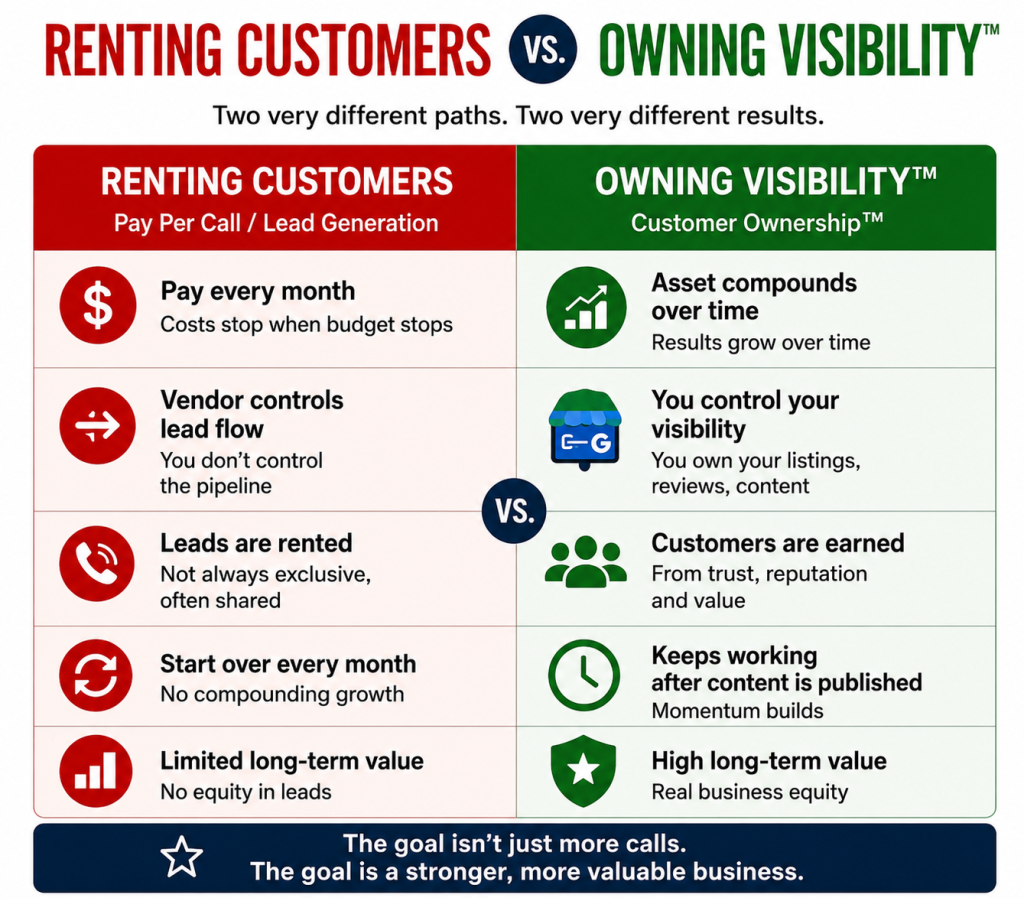
The Difference Between Renting Customers and Owning Visibility
There are two very different ways to grow an appliance repair business.
Renting Customers
- Buying leads every month
- Constant advertising spend
- Depending on third-party platforms
- Starting over every month
Customer Ownership™
- Growing your Google Business Profile
- Earning more Google reviews
- Publishing helpful content
- Showcasing completed repairs
- Building referral systems
- Staying connected with past customers
- Improving your website
- Creating videos and educational resources
These become Visibility Assets™.
Unlike advertising, they continue working long after they’re created.
Every review, every repair photo, every article, and every satisfied customer becomes another asset helping future customers find and trust your business.
When Buying Appliance Repair Leads Makes Sense
Buying leads isn’t inherently good or bad.
Like any marketing strategy, it depends on your goals.
Pay per call can make sense when:
- You’re launching a new business.
- You’re entering a new market.
- You recently hired additional technicians.
- You’re experiencing a seasonal slowdown.
- You need immediate revenue while building long-term marketing assets.
The key is treating purchased leads as a bridge—not a permanent business model.
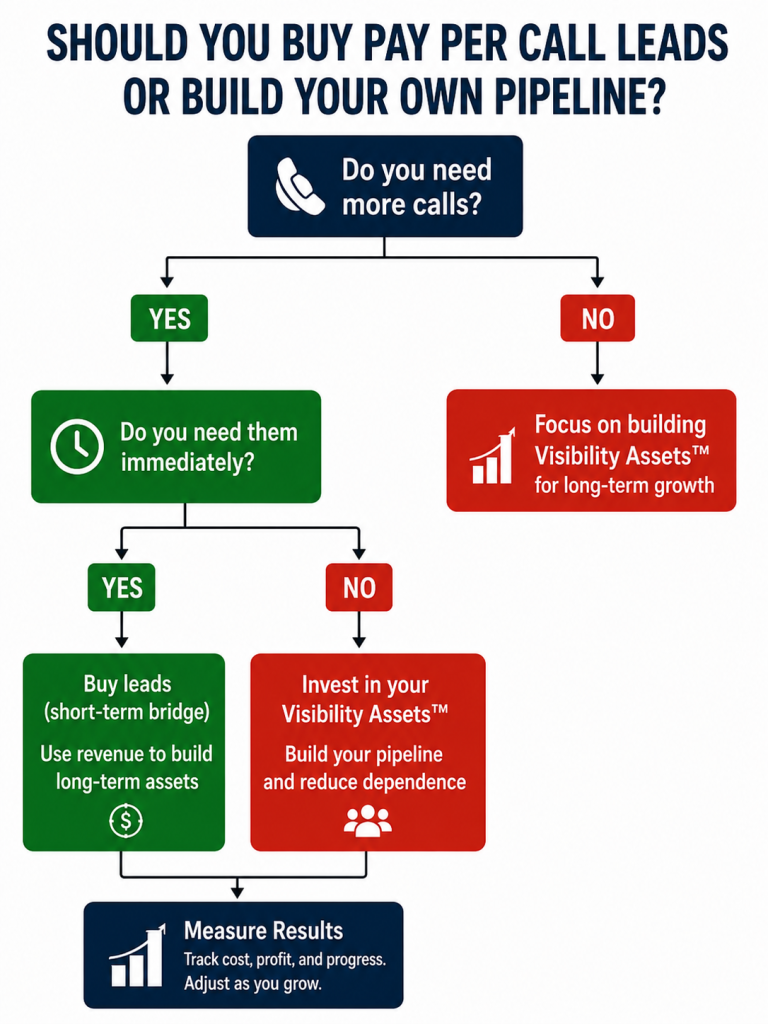
Use purchased leads to create cash flow while building assets that reduce your dependence over time.
Build Assets While You Buy Leads
One of the smartest strategies is combining both approaches.
Use purchased leads to generate cash flow today.
Then reinvest part of that revenue into assets that reduce your dependence on paid advertising over time.
That might include:
- Improving your Google Business Profile.
- Collecting more five-star reviews.
- Publishing repair reports and educational articles.
- Optimizing your website for local searches.
- Creating helpful videos.
- Building an email list to stay connected with past customers.
Over time, more of your business begins coming from assets you own rather than leads you rent.
Pay Per Call vs Customer Ownership™
Neither approach is inherently wrong.
The difference is whether you’re building a business that becomes more valuable every year or one that must continually purchase its next customer.
| Factor | Pay-Per-Call Leads | Customer Ownership™ |
|---|---|---|
| Results | Immediate | Compounding over time |
| Cost | Continuous monthly expense | Cost per lead often decreases |
| Control | Vendor controls lead flow | You control your visibility |
| Reviews | Usually none | Reviews increase and compound |
| Brand Equity | Limited | Builds trust and authority |
| Long-Term Value | Low | High—real business equity |
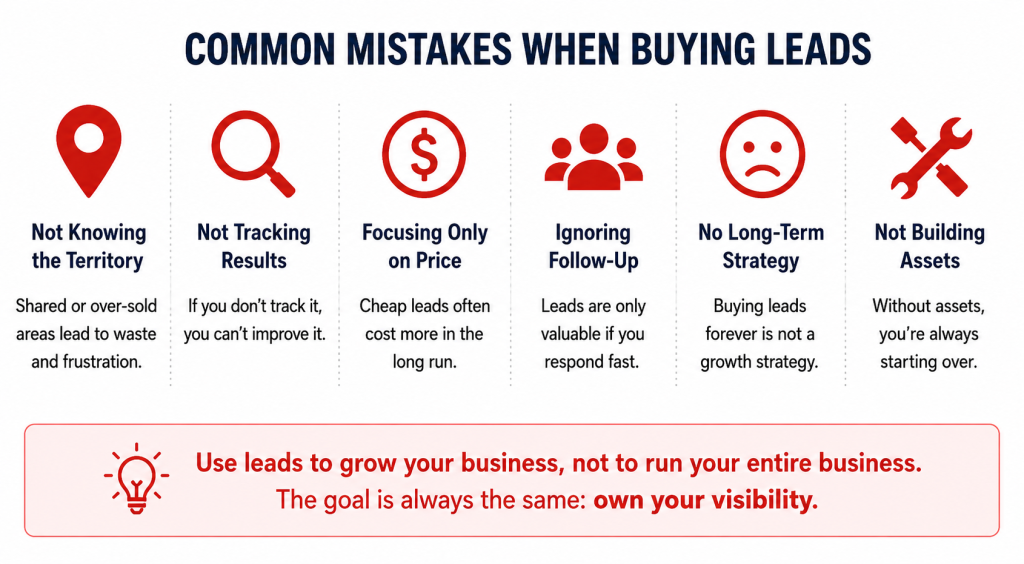
Common Mistakes When Buying Appliance Repair Leads
Buying appliance repair leads can be an effective way to grow your business, especially if you’re just getting started or trying to keep technicians busy. However, many companies make the mistake of relying on lead providers without understanding how to maximize their return on investment.
The goal isn’t simply to buy more leads—it’s to turn those leads into long-term customers while building marketing assets that reduce your dependence on paid lead sources over time.
Here are some of the most common mistakes to avoid.
1. Choosing the Lowest Cost Instead of the Highest Value
It’s natural to compare providers based on cost per lead or cost per call, but the cheapest lead isn’t always the best investment.
A lower-priced lead that rarely converts can end up costing far more than a higher-quality lead that consistently turns into paying customers. Instead of focusing only on price, evaluate lead quality, conversion rates, average ticket value, and the lifetime value of the customers you acquire.
2. Depending on a Single Lead Source
Many contractors build their entire business around one lead provider. While that may work for a period of time, it creates unnecessary risk.
Pricing can change. Lead quality can fluctuate. Service areas may be adjusted, or a provider may change how leads are distributed. If too much of your business depends on one company, those changes can have an immediate impact on your revenue.
Diversifying your marketing helps create a more stable business.
3. Ignoring What Happens After the First Job
The first service call is only the beginning of the customer relationship.
Many businesses spend significant money acquiring new customers but do very little to encourage repeat business or referrals. Once the repair is complete, communication often stops.
Every customer should become part of your long-term marketing strategy through review requests, follow-up communication, helpful maintenance information, and occasional reminders that keep your company top of mind when the next appliance needs service.
4. Failing to Build Your Own Visibility
Purchased leads can generate immediate opportunities, but they don’t always improve your visibility in Google search results, increase your review count, strengthen your website, or grow your online reputation.
Those assets are what continue producing customers long after you’ve stopped paying for individual leads.
The strongest businesses use purchased leads to generate revenue while simultaneously investing in their own Visibility Assets™, including their Google Business Profile, customer reviews, website, helpful content, job photos, and educational resources.
5. Not Tracking the Right Numbers
Many contractors only track how many calls they receive.
A much better approach is to understand the complete picture:
- Cost per lead
- Conversion rate
- Average repair ticket
- Average customer lifetime value
- Cost per acquired customer
These numbers provide a much clearer picture of which marketing efforts are truly profitable.
6. Thinking Short-Term Instead of Long-Term
Lead generation solves today’s scheduling problem.
Customer ownership solves next year’s growth problem.
Businesses that consistently invest in their own reputation and visibility often find that, over time, they rely less on purchased leads because more customers are finding them directly through Google searches, referrals, repeat business, and online reviews.
That’s not because purchased leads stopped working. It’s because their own marketing assets became increasingly valuable.
Build While You Buy
There’s nothing wrong with buying appliance repair leads. In fact, they can be an excellent way to generate immediate revenue and keep your technicians productive.
The key is to avoid becoming dependent on them.
The companies that build lasting businesses don’t choose between buying leads and building their own marketing… they do both. They use purchased leads to create cash flow while continually investing in Visibility Assets™ that compound over time.
That’s how you transition from renting customers each month to building a business that generates opportunities long after today’s advertising budget has been spent.
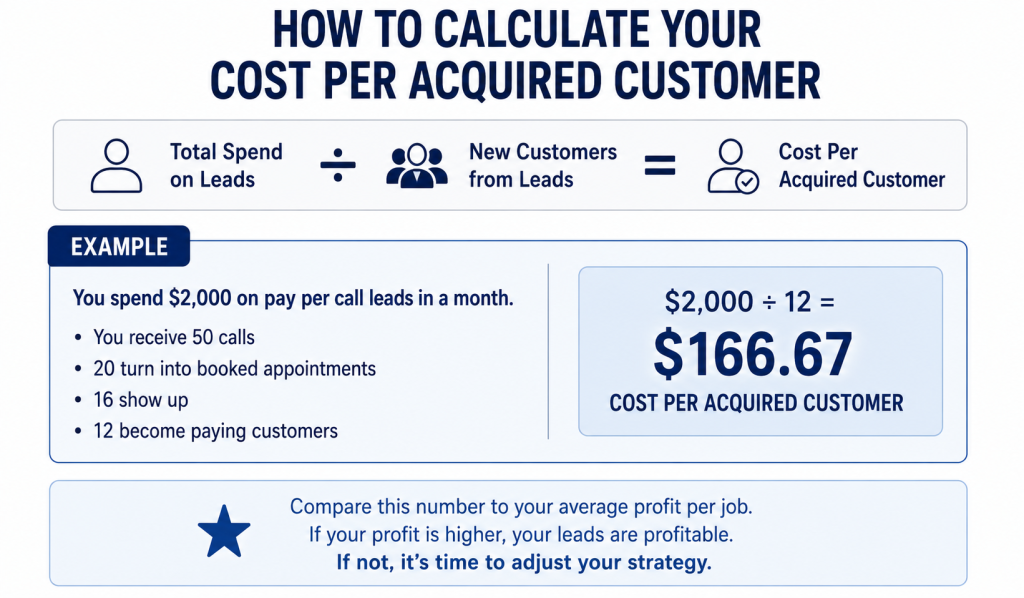
How to Calculate Cost Per Acquired Customer
Many appliance repair companies know what they pay for a lead, but far fewer know what it actually costs to acquire a new customer.
Those are two very different numbers.
A lead is simply someone who contacts your business. An acquired customer is someone who schedules service, completes the repair, and pays for the job. Understanding that difference can help you make better marketing decisions and compare different lead sources more accurately.
Start with the Basics
The simplest formula is:
Cost Per Acquired Customer = Total Marketing Cost ÷ Number of New Customers
For example, imagine you spend $2,000 during the month on pay-per-call leads.
That investment generates:
- 40 incoming calls
- 28 booked appointments
- 22 completed repair jobs
Your calculation would look like this:
$2,000 ÷ 22 customers = $90.91 per acquired customer
This gives you a much clearer picture of your true customer acquisition cost than simply looking at the price of each lead.
Go Beyond Cost Per Lead
Many marketing companies advertise low costs per lead, but cost per lead only tells part of the story.
For example:
Provider A
- $40 per lead
- 50 leads purchased
- 20 paying customers
Cost Per Acquired Customer: $100
Provider B
- $70 per lead
- 30 leads purchased
- 24 paying customers
Cost Per Acquired Customer: $87.50
Even though Provider B charges more per lead, they actually deliver customers at a lower overall acquisition cost because a higher percentage of their leads become paying jobs.
That’s why focusing only on lead price can sometimes be misleading.
Don’t Forget Customer Lifetime Value
The first repair isn’t always the end of the relationship.
A satisfied customer may call you again when another appliance breaks, recommend you to friends and neighbors, or leave a positive Google review that helps attract future customers.
Over time, one acquired customer can generate far more value than the original repair invoice.
That’s one reason businesses that invest in customer retention, online reviews, and long-term visibility often see their marketing become more profitable over time.
The Goal Isn’t the Lowest Cost—It’s the Highest Return
Reducing acquisition cost is important, but it shouldn’t come at the expense of quality.
The most successful appliance repair companies focus on acquiring profitable customers, delivering excellent service, and building marketing assets that continue producing business long after the initial advertising spend.
As your Google Business Profile grows, your review count increases, your website earns more visibility, and past customers continue referring friends and family, you’ll often find that more of your future customers come directly to you.
That’s the power of Customer Ownership™.
Instead of paying for every opportunity forever, you’re building Visibility Assets™ that continue working for your business month after month, reducing your dependence on purchased leads while increasing the long-term return on every marketing dollar you invest.
My Experience Generating Appliance Repair Leads
For years, I built and operated websites that generated appliance repair leads for service companies across the country. I wasn’t just studying lead generation, I was actively creating it. Every day, my focus was on helping appliance repair businesses get more phone calls through search engine optimization (SEO), Google Business Profiles, websites, and online marketing.
Some leads were sold directly to independent appliance repair companies. Others were purchased by larger lead generation companies that distributed service requests nationwide. That gave me a unique perspective on the appliance repair industry from multiple angles—not only generating leads, but also seeing how different businesses handled them after the phone rang.
Over time, I noticed something important.
Some companies treated every lead as a one-time transaction. Their goal was simply to keep buying enough calls to stay busy.
Others took a different approach.
They understood that every new customer represented an opportunity to build something much more valuable than a completed repair. They collected reviews, documented their work with photos, improved their Google Business Profile, strengthened their website, stayed connected with past customers, and earned referrals that generated future business.
Over time, those companies became less dependent on purchased leads because they were building marketing assets that continued working long after the original service call.
That realization changed the way I think about marketing.
Lead generation is important, especially when you need immediate business. There’s nothing wrong with buying quality leads if they help keep your technicians productive and generate positive cash flow.
But I also believe every purchased lead should become an opportunity to strengthen your own business.
Every completed repair can produce a Google review.
Every job can provide before-and-after photos.
Every satisfied customer can become a future referral.
Every repair story can become helpful content for your website.
Every interaction can improve your visibility in Google and make it easier for the next customer to find you directly.
That’s the philosophy behind Customer Ownership™.
Instead of viewing marketing as something you rent month after month, I believe businesses should continually invest in assets that appreciate over time. Reviews grow. Helpful content continues attracting visitors. A well-optimized Google Business Profile earns more visibility. Strong customer relationships generate repeat business and referrals.
Those assets don’t replace lead generation, they make every lead more valuable.
Today, that’s the approach I encourage every appliance repair company to take. Use lead generation when it makes sense, but never stop building the assets that help your business earn customers on its own.
The companies that achieve the most sustainable growth aren’t necessarily the ones spending the most on advertising. They’re the ones using each new customer to create even more opportunities in the future.
That’s how you move from simply generating leads to building a business with lasting Customer Ownership™.
Watching those differences firsthand is what ultimately led me to develop the Customer Ownership™ framework. I saw that the most successful companies weren’t just buying customers—they were using every completed job to build assets that generated future business.
Frequently Asked Questions
Appliance repair pay-per-call leads are phone calls from homeowners looking for appliance repair services. Instead of paying for advertising campaigns yourself, you pay a lead generation company for qualified phone calls that match your service area and business criteria. Some providers charge for every call that meets certain requirements, while others sell exclusive or shared leads. Pay-per-call can be an effective way to generate immediate business, especially for new companies or those looking to fill open schedule capacity.
They can be, especially for new businesses or companies needing immediate work. The key is making sure the cost of acquiring each customer is profitable.
They solve different problems. Pay per call provides immediate opportunities, while SEO builds long-term visibility that can continue generating customers for years.
The cost of appliance repair leads varies depending on your market, competition, and the lead provider. Some companies charge per lead, while others charge per qualified phone call. Higher-quality or exclusive leads generally cost more than shared leads. Instead of focusing only on the price of each lead, compare your overall cost per acquired customer by looking at how many leads actually become paying repair jobs.
It depends on the provider. Some companies sell exclusive leads that are sent only to your business, while others distribute the same lead to multiple contractors. Exclusive leads typically cost more but often convert at a higher rate because you’re not competing with other companies for the same customer. Always ask a provider whether their leads are exclusive, shared, or generated through a bidding system before signing up.
Calculate your total marketing spend and divide it by the number of new paying customers you acquired during the same period.
Formula:
Cost Per Acquired Customer = Total Marketing Cost ÷ Number of New Customers
For example, if you spend $2,000 on marketing and complete 20 new repair jobs, your cost per acquired customer is $100. This metric provides a much better picture of marketing performance than simply looking at the cost of individual leads.
Buying leads can be a smart strategy for a new appliance repair business that needs immediate phone calls while building its reputation and online presence. However, purchased leads should be viewed as a way to generate cash flow, not as a permanent marketing strategy. As your review count grows, your Google Business Profile improves, and your website gains visibility, you can gradually reduce your dependence on purchased leads and generate more customers organically.
Not necessarily. Many successful businesses use paid lead generation strategically while investing in assets that gradually reduce their dependence on purchased leads.
Absolutely. In fact, that’s the strategy I recommend.
Purchased leads can help keep your technicians busy today while you invest in assets that generate customers tomorrow. Every completed repair can produce a Google review, job photos, helpful website content, referrals, and repeat customers. Over time, those Visibility Assets™ increase your online presence and reduce your reliance on paid lead providers. The goal isn’t to choose one strategy or the other, it’s to use today’s leads to build tomorrow’s customer pipeline.
The most successful appliance repair companies generate their own leads by investing in long-term Visibility Assets™. That includes building a strong Google Business Profile, earning consistent customer reviews, publishing helpful content on their website, sharing job photos, creating educational videos, and staying connected with past customers through follow-up communication. While these strategies take longer than buying leads, they continue generating customers long after the initial investment has been made and help build lasting Customer Ownership™.
Most businesses begin seeing meaningful improvements within several months, although timing varies depending on competition, your market, and the work already completed.
Build a Business That Doesn't Start Over Every Month
One of the biggest challenges with buying appliance repair leads is that every month starts at zero.
When the lead service sends calls, your schedule fills up. When you stop paying, the calls often stop too.
There’s nothing inherently wrong with buying leads. Many successful appliance repair companies use them to supplement their marketing, especially when they’re new or expanding into a new service area.
The problem comes when lead generation becomes your only strategy.
Every completed service call is an opportunity to build something that keeps working long after the customer has paid the invoice.
A five-star review builds trust with future customers.
Job photos strengthen your Google Business Profile.
Helpful website content attracts people searching for appliance repair in your area.
Email and text follow-up keep your business top of mind for repeat service and referrals.
These are Visibility Assets™—marketing assets that continue creating value long after the original job is complete.
Over time, these assets begin working together. More reviews improve trust. Better visibility generates more calls. More completed jobs create more reviews, photos, and referrals.
That’s how successful appliance repair companies gradually reduce their dependence on purchased leads.
Instead of starting over every month, they’re building a customer pipeline they increasingly own.
That’s the difference between renting customers and building Customer Ownership™.
STOP RENTING CUSTOMERS. STAR BUILDING YOUR OWN CUSTOMER PIPELINE.
You’ve seen the pros and cons of buying appliance repair leads.
Now discover how successful appliance repair companies build a customer pipeline they actually own.
Whether you’re buying leads today or looking for a better long-term strategy, the next step starts here.