For years, the standard advice for appliance repair companies was simple: if you repair refrigerators, create a refrigerator repair page. If you service washers, publish a washer repair page. If you work on a particular brand, consider a brand-specific page.
That advice still has value. Customers need clear explanations of the services you offer. But a more useful question is emerging: what evidence can a customer find that your company has actually performed those repairs?
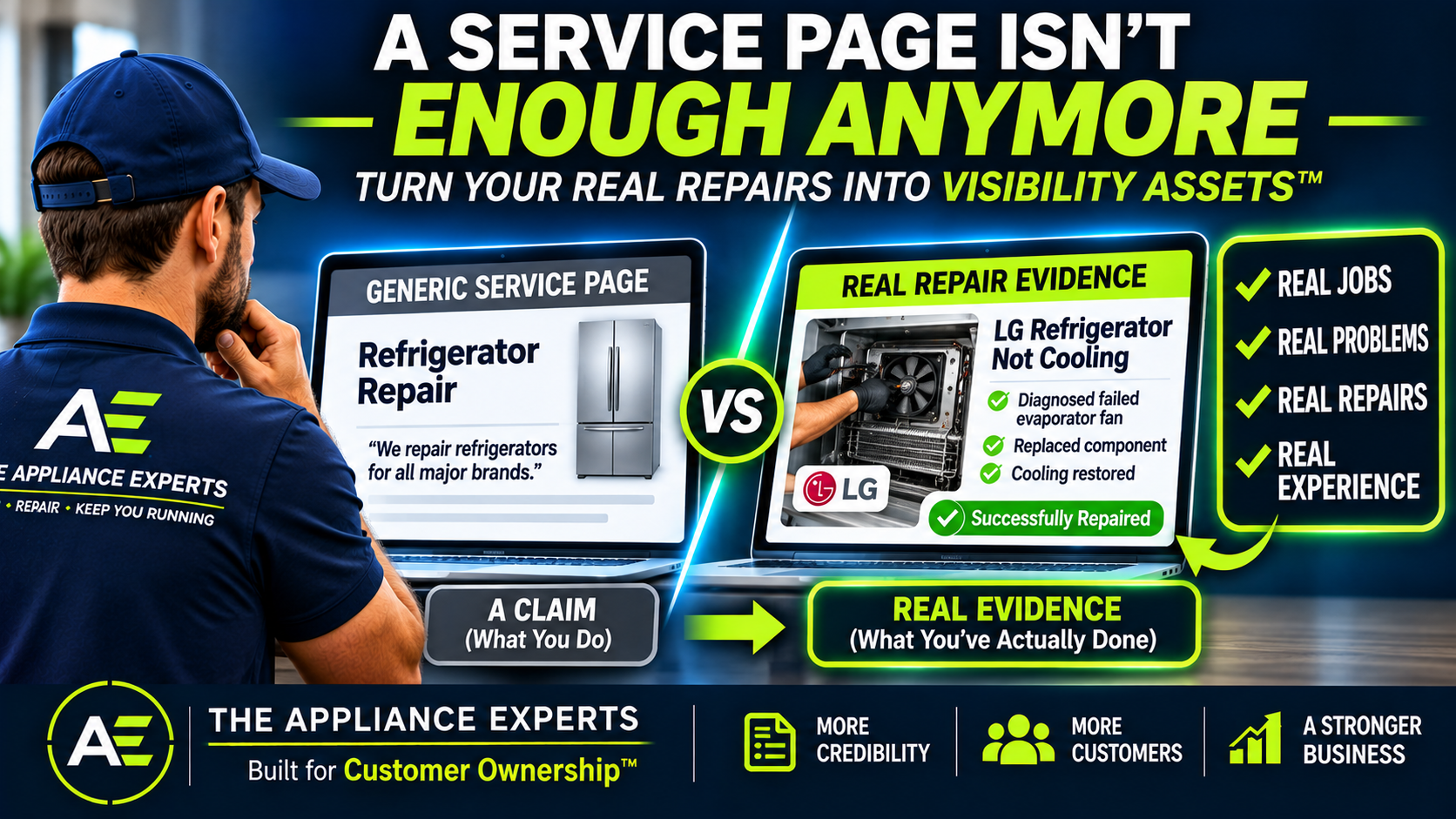
Anyone can publish a page saying, “We provide professional refrigerator repair for all major brands.” That statement tells people what the business offers. It does not, by itself, show the experience behind the claim.
Two Companies Can Have the Same Service Page
Imagine two appliance repair companies with similar refrigerator repair pages.
Company A: The claim
Its page says it repairs refrigerators, lists common brands, and invites customers to schedule service. That may be accurate and useful, but the page stands mostly on its own.
Company B: The supporting evidence
Company B also has a refrigerator repair page. But elsewhere on its site and profiles, customers can find real examples: a refrigerator that stopped cooling, a failed evaporator fan assembly, a control replacement, photographs from actual service visits, and reviews that mention refrigerator repairs.
Those examples are illustrative, not claims about any particular company. The difference is straightforward: one site states a capability; the other gives customers relevant evidence to evaluate it.
From Service Page to Visibility Asset™
A strong service page can be a useful Visibility Asset™—a digital resource that helps people discover, understand and evaluate your expertise. But the page need not stand alone.
Every completed service call can generate useful source material:
Appliance brand and model
Customer-reported concern
Technician diagnosis and confirmed failed component
Repair performed and whether it was completed
Outcome and appropriate customer feedback
Photographs, when available and authorized
Much of this information already lives in dispatch software, invoices, or technicians’ notes. If it stays there, it may never help a future customer understand what the business has actually done.
The Process: Repair → Capture → Document → Distribute
1. Repair
Start with work that actually happened. The service event—not a keyword list—is the source of the story.
2. Capture
Record the complaint, diagnosis, work performed, and result accurately. If a detail was not documented, do not invent it. Remove personal information and obtain permission for any customer-identifying material or photographs as needed.
3. Document
Turn an appropriate service event into a clear, useful account. Explain what the customer experienced, what the technician found, what was done, and what happened afterward. Avoid presenting an estimate or an uncompleted repair as a successful outcome.
4. Distribute
Where relevant, connect that documentation to the matching service page, supporting educational content, and other appropriate channels. A useful example should make it easier for a customer to understand the service—not merely create another page for search engines.
The Visibility Disconnect™
The Visibility Disconnect™ occurs when a business’s real-world expertise and reputation are not fully represented by information that customers, search engines and AI systems can discover online.
A technician may have repaired hundreds of refrigerators. Yet if the company’s entire online footprint is one generic refrigerator repair page, much of that experience remains invisible. More generic pages do not necessarily solve that problem. Accurate documentation of actual work can help close the gap.
Look Beyond Your Competitors’ Service Pages
Choose one important service, such as refrigerator repair, and compare a few local competitors. Look beyond whether they have a service page. Do they show actual service examples? Do reviews mention that appliance? Are there relevant photographs, useful explanations, or evidence of completed work?
This exercise can reveal a difference between polished marketing language and a broader body of evidence. It can also reveal where your own site needs improvement.
Evidence Helps Customers Decide, Not Just Discover
Imagine a homeowner whose Samsung refrigerator has stopped cooling. Two companies both claim to service Samsung refrigerators. One also provides a clear example of a similar issue it diagnosed and repaired.
That example does not guarantee a booking or a search ranking. But it may give the homeowner a more concrete reason to consider the company. Effective visibility involves both getting found and giving people enough confidence to get in touch.
Documented Repair Examples: A Practical Way to Preserve Experience
Documented repair examples are one way to turn completed service events into useful customer-facing evidence. Each example should make clear which appliance was serviced, what concern was reported, what the technician actually diagnosed, what work was performed, and whether the repair was completed. Do not invent missing details or imply an unsuccessful job was successfully repaired.
A report should not exaggerate the outcome or fill missing details with assumptions. Over time, carefully documented repairs can create a history of real service experience that a generic service page cannot supply on its own.
Start With One Real Repair
You do not need to create dozens of pages this week. Pick one service that matters to your company and take six practical steps:
Review its existing service page.
Find other evidence supporting that service on your website and profiles.
Look through recent completed jobs for a suitable documented example.
Identify genuine reviews that specifically mention the service.
Choose one repair whose facts and outcome can be accurately presented.
Link relevant evidence back to the service page where it helps the reader.
If you removed your main service page, what other online evidence would show that you actually perform that type of repair? The answer may reveal your next opportunity to build a stronger online presence.
Don’t Just Say What You Repair. Show What You’ve Done.
Creating content is easier than ever. Creating real service experience is different. Your technicians generate knowledge with each diagnosis and every properly documented repair. The opportunity is to preserve that experience and make it useful to the next customer.
A service page tells people, “We repair refrigerators.” Supporting evidence can show, “Here is the kind of refrigerator work we have actually performed.” Both have a place in a more complete online presence.
For a broader view, examine how your company appears across different searches and cities—and whether independent recognition reinforces the story your own website tells.
Find Your Visibility Disconnect™
The complimentary Visibility Snapshot™ reviews important parts of your appliance repair company’s online presence to help identify practical gaps in how your business gets found, gets chosen and gets remembered.