The Customer Ownership System™ for Appliance Repair Companies
What happens after you complete the repair may be one of the biggest overlooked opportunities in your appliance repair marketing.
Most appliance repair companies spend considerable time and money trying to generate the next service call.
Google Ads. Local Services Ads. SEO. Google Business Profile. Lead companies. Pay-per-call.
All of those channels can work.
But if you acquire a customer, complete the repair, collect payment and never build a relationship with that customer, tomorrow you’re right back where you started:
Trying to acquire another customer.
The Customer Ownership System™ is a different way of thinking about appliance repair marketing.
Instead of viewing every service call as a transaction that ends when the invoice is paid, it asks:
What can your business build from the customer relationship you’ve already paid to acquire?
Watch: The Customer Ownership System™
In this presentation, I walk through the Customer Ownership System™, Visibility Assets™, customer databases, Review Moments™, the Visibility Flywheel™ and three practical steps appliance repair companies can begin implementing now.
A Job Is Not the Same Thing as a Customer
Appliance repair businesses naturally think in terms of jobs.
How many calls came in?
How many jobs are on the schedule?
How many repairs did the technicians complete?
What was the average ticket?
Those are important numbers.
But there’s another question worth asking:
How many customers has your company served that you never heard from again?
Maybe it’s hundreds.
For an established multi-technician company, it could be thousands.
Those homeowners already know your business.
You’ve already been inside their homes.
They’ve already trusted you with an appliance.
And assuming you provided a good experience, you’ve already accomplished one of the hardest parts of marketing:
Turning a stranger into a customer.
Yet the traditional appliance repair transaction often looks like this:
Lead → Job → Payment → Done
The company then goes back into the market tomorrow and tries to find another stranger.
Customer Ownership™ changes what happens after the lead becomes a customer.
Lead → Customer → Review → Database → Stay Connected™ → Repeat Service → Referral
The objective isn’t merely to complete more transactions.
It’s to build something from the customers your marketing is already producing.
1,000 Repairs or 1,000 Customer Relationships?
Imagine your appliance repair company completes 1,000 repairs this year.
At the end of the year, you could have 1,000 invoices and the revenue those jobs produced.
That’s obviously valuable.
But what else did those 1,000 service calls create?
Did customers leave reviews?
Did you capture their contact information?
Do you know which appliances you serviced?
Are those customers part of an organized database?
Do you have an appropriate way to stay connected?
Will they remember your company when another appliance breaks?
Will they recommend you when a neighbor asks who repaired their refrigerator?
If all you created were invoices, you completed 1,000 transactions.
But those same service calls also created the opportunity to build 1,000 customer relationships.
And that’s especially important in appliance repair.
The homeowner whose refrigerator you repaired doesn’t own only a refrigerator.
They may also have a washer, dryer, dishwasher, range and other appliances.
Those appliances aren’t all going to need service today.
But that customer may need an appliance repair company again.
The question is whether they’ll remember yours.
Your Marketing Should Build Assets
This also connects to what I call the Visibility Disconnect™, the gap that can exist when the quality, expertise and reputation of a real-world appliance repair business aren’t fully represented by what customers, search engines and AI platforms can discover online.
This is where Visibility Assets™ enter the Customer Ownership System.
Advertising and lead generation can produce customers today.
At the same time, your business can be building assets that contribute to future visibility, trust and customer relationships.
Those assets can include:
- Your Google Business Profile
- Customer reviews
- Your website
- Your customer database
- Photos and videos from real repair jobs
- Content demonstrating your repair expertise
- Customer relationships
A customer review can help the next homeowner evaluate your company.
A real repair photo can demonstrate experience.
Useful content can help someone discover your business.
Your website can help turn that visitor into a customer.
And your customer database can help you maintain relationships with people you’ve already served.
The goal isn’t to stop advertising.
It’s to make sure you’re building something while you advertise.
Your Customer Database May Be an Overlooked Business Asset
Of all the assets an appliance repair company can build, the customer database may be one of the most overlooked.
Think about how much time and money goes into acquiring a new customer.
You may have paid for the click.
Paid for the lead.
Invested in SEO.
Built your Google Business Profile.
Generated reviews.
Answered the phone.
Scheduled the appointment.
Sent a technician to the home.
And successfully completed the repair.
By that point, you’ve invested significantly more than marketing dollars.
You’ve earned a customer relationship.
Yet after the invoice is paid, information about that customer may simply sit inside your dispatch software, invoicing system or CRM without ever contributing to the business again.
For an established appliance repair company, that could represent years of customer relationships that have already been built.
Your database might contain:
- Customer name
- Phone number
- Email address
- Service address
- Appliance serviced
- Repair history
- Date of service
The exact information will depend on your systems and what customers have agreed to provide.
The important first step isn’t buying another piece of software.
It’s discovering what you already have.
How many customers has your company served during the past three, five or ten years?
Where is that information stored?
What information have you captured?
And do you have an appropriate way to stay connected with those customers?
Those questions can uncover an asset that was already sitting inside your business.
Every Successful Repair Can Create a Review Moment™
The customer database isn’t the only asset created during a service call.
A successful repair can also create what I call a Review Moment™.
Imagine a homeowner whose refrigerator stopped cooling.
They’re worried about losing their food.
Your technician arrives, diagnoses the problem, completes the repair and gets the refrigerator cooling again.
At that moment, the customer has just experienced the value of your service.
That’s the Review Moment™.
The traditional approach is often to hope that the customer eventually decides to leave a review.
Maybe the technician remembers to ask.
Maybe an automated text goes out hours later.
Maybe nothing happens.
A more intentional process looks like this:
Successful Repair → Happy Customer → Review Moment™ → Request → Review
The goal isn’t to pressure customers or tell them what to say.
It’s to recognize that there is a natural point in the customer experience when requesting honest feedback makes sense.
Human Moment → Automated Execution
This is also where the technician and automation can complement each other.
Software is excellent at consistency.
A system can send a review request after every qualifying completed job without relying on someone in the office to remember.
But software doesn’t replace the human interaction that just occurred inside the customer’s home.
A technician might simply say:
“I’m glad we got that refrigerator working for you. You’ll receive a quick review request from us.”
The technician creates the context.
The system makes sure the request happens.
Human Moment → Automated Execution
That combination can be much more intentional than simply sending automated review requests into the customer’s phone with no context.
And it turns review generation into a repeatable process connected to the actual customer experience.
The Customer May Be More Valuable Than the Review
But there’s another mistake appliance repair companies can make.
They get the review…
and then consider the process finished.
The customer left five stars.
The review appears on Google.
Mission accomplished.
Except the customer who left that five-star review may ultimately be more valuable than the review itself.
Think about what you now know about that person.
They’ve trusted your company enough to invite a technician into their home.
You’ve successfully solved a problem for them.
They’ve had a positive enough experience to provide feedback.
And they probably own several other appliances.
The refrigerator you repaired today may not be the next appliance that needs service.
It could be their washer.
Dryer.
Dishwasher.
Range.
Or another appliance entirely.
They may also have a friend, neighbor or family member who needs appliance repair.
That’s why the process shouldn’t necessarily end here:
Customer → Review → Done
It can continue:
Customer → Review → Stay Connected™ → Repeat Service → Referral → New Review Moment™
The review is an asset.
So is the relationship that produced it.
Stay Connected™ Without Becoming Annoying
Customer Ownership™ doesn’t mean bombarding previous customers with promotions.
And it doesn’t mean treating your customer database as an excuse to send constant sales messages.
The objective is to maintain a useful, appropriate connection with customers who have agreed to hear from you.
That could eventually include things like:
- Helpful appliance-care information
- Seasonal reminders
- Relevant company updates
- Useful maintenance tips
- Occasional service reminders
- Other communications that give customers a reason to remember your company
The exact strategy will vary by business.
But the underlying objective is simple:
When that customer needs appliance repair again, you don’t want to be a stranger.
They’ve already gone through the process of finding a company and deciding whether they can trust you.
If you’ve maintained that relationship appropriately, the next service call doesn’t necessarily have to begin with another search for an appliance repair company.
Customer Ownership™ Doesn’t Mean Stop Generating Leads
Customer Ownership™ isn’t an argument against lead generation.
Appliance repair companies still need new customers.
Google Ads can work.
Local Services Ads can work.
Appliance Repair SEO can work.
Google Business Profile optimization can work.
Lead companies and pay-per-call can work.
If a marketing channel is producing profitable customers for your business, the goal isn’t to turn it off.
The goal is to make every customer that channel produces more valuable over time.
Instead of measuring the value of your marketing only by the revenue from the first service call, consider what else that customer relationship can create.
A customer can produce:
- Revenue from the original repair
- A customer review
- Another relationship in your database
- Repeat service
- Referrals
- Photos, feedback or other evidence of real repair work
- Additional Review Moments™ in the future
The acquisition channel brought you the customer.
Customer Ownership™ asks what you build from that point forward.
Get Found. Get Chosen. Get Remembered.
A strong appliance repair marketing system needs to do more than generate visibility.
I think about the customer journey in three stages:
GET FOUND
Can customers discover your company when they need appliance repair?
GET CHOSEN
When they find you, do your reviews, reputation and expertise give them a reason to trust you?
GET REMEMBERED
After you’ve successfully served them, have you built a relationship that makes it easier for them to return or refer someone else?
Visibility Assets™ help you get found.
Your reputation helps you get chosen.
Customer Ownership™ helps you get remembered.
Most appliance repair marketing concentrates heavily on getting found.
Customer Ownership™ makes sure the opportunity doesn’t end once the customer chooses you.
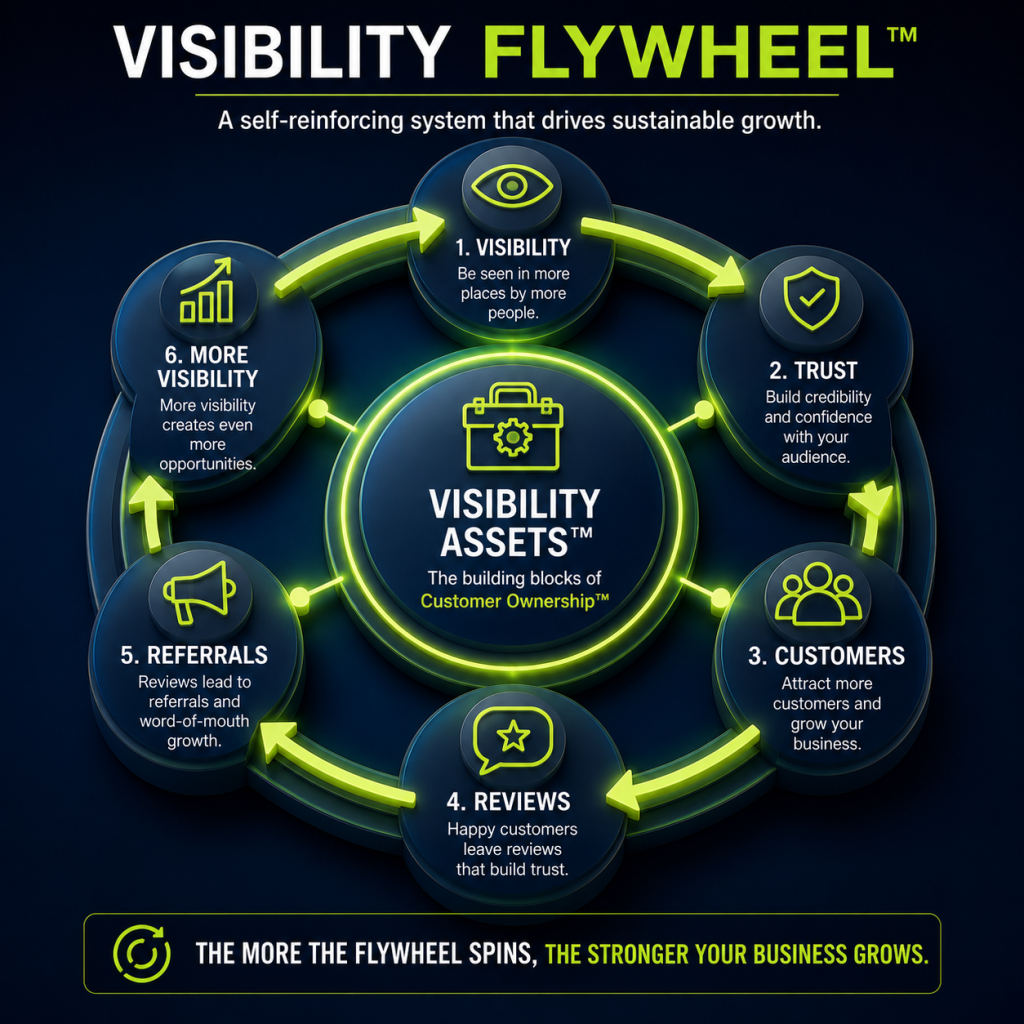
From One Service Call to the Visibility Flywheel™
When these pieces begin working together, marketing becomes less about isolated tactics.
A successful repair can create a happy customer.
That customer can create a review.
The review can strengthen trust and visibility.
Greater visibility can help attract another customer.
That customer creates another opportunity for a successful repair, another relationship and another Review Moment™.
Over time, those individual actions can begin reinforcing one another:
Visibility → Trust → Customers → Reviews → Referrals → More Visibility
That’s the Visibility Flywheel™.
The objective isn’t to eliminate the need for marketing.
It’s to make today’s marketing contribute to something that can continue creating value tomorrow.
Instead of continually renting attention from another platform, you’re also building assets your business can carry forward.
Three Things You Can Do This Week
You don’t need to implement an elaborate new system to begin thinking differently about Customer Ownership™.
Start with three things.
1. Find Your Customer Database
Where does your previous customer information currently live?
Look inside your dispatch software, CRM, invoicing system, phone and other customer records.
You may discover that you’ve already accumulated years of customer relationships without thinking of them as a marketing asset.
2. Identify Your Review Moment™
Look at what happens immediately after a successful repair.
Is there a natural moment when the technician can set the expectation that the customer will receive a request for feedback?
Then ask whether your current system consistently follows through.
Remember:
Human Moment → Automated Execution
The technician creates the context.
Automation creates consistency.
3. Decide How You’ll Stay Connected™
What happens after the invoice is paid and the review request is sent?
If the answer is nothing, that’s an opportunity worth examining.
Think about how your company can appropriately stay connected so that when another appliance breaks, the customer remembers the company that already helped them.
You don’t have to solve the entire system today.
Start by identifying what happens now.
Where Does Your Appliance Repair Business Stand Today?
Customer Ownership™ is only one part of the larger marketing picture.
You might discover that you already have a valuable customer database but aren’t doing anything with it.
Your review process may be inconsistent.
Your Google Business Profile may have opportunities you’re missing.
Your website may not be supporting your visibility or converting visitors effectively.
Your local search presence may need attention.
Or something completely different may deserve priority.
That’s why I don’t believe every appliance repair company should automatically be prescribed the same marketing solution.
We won’t know until we look.
Request Your Complimentary Visibility Snapshot™
The Visibility Snapshot™ is a personalized review of your appliance repair company’s current online visibility.
We’ll review areas including your:
- Google Business Profile
- Website
- Reviews and reputation
- Local visibility
- Other Visibility Assets™
Then we’ll identify the opportunities we believe deserve your attention first.
No automated score.
No generic audit.
No assumption that you need the same thing as the next appliance repair company.
Find out what’s strengthening—or holding back—your visibility.
Final Thought
The next lead matters.
The next service call matters.
But so does the customer you served yesterday.
You’ve already invested the time, money and effort required to turn that person from a stranger into a customer.
Don’t automatically let that relationship end when the invoice is paid.
Don’t just complete the job. Build the customer relationship.
Related Resource
Listen: Customer Ownership™
Prefer to listen? In this episode of Appliance Repair Marketing Secrets, I break down the Customer Ownership™ strategy and how appliance repair companies can turn completed service calls into reviews, customer relationships, repeat business, referrals and long-term Visibility Assets™.
Listen to Customer Ownership™: Stop Renting Customers and Start Building an Asset